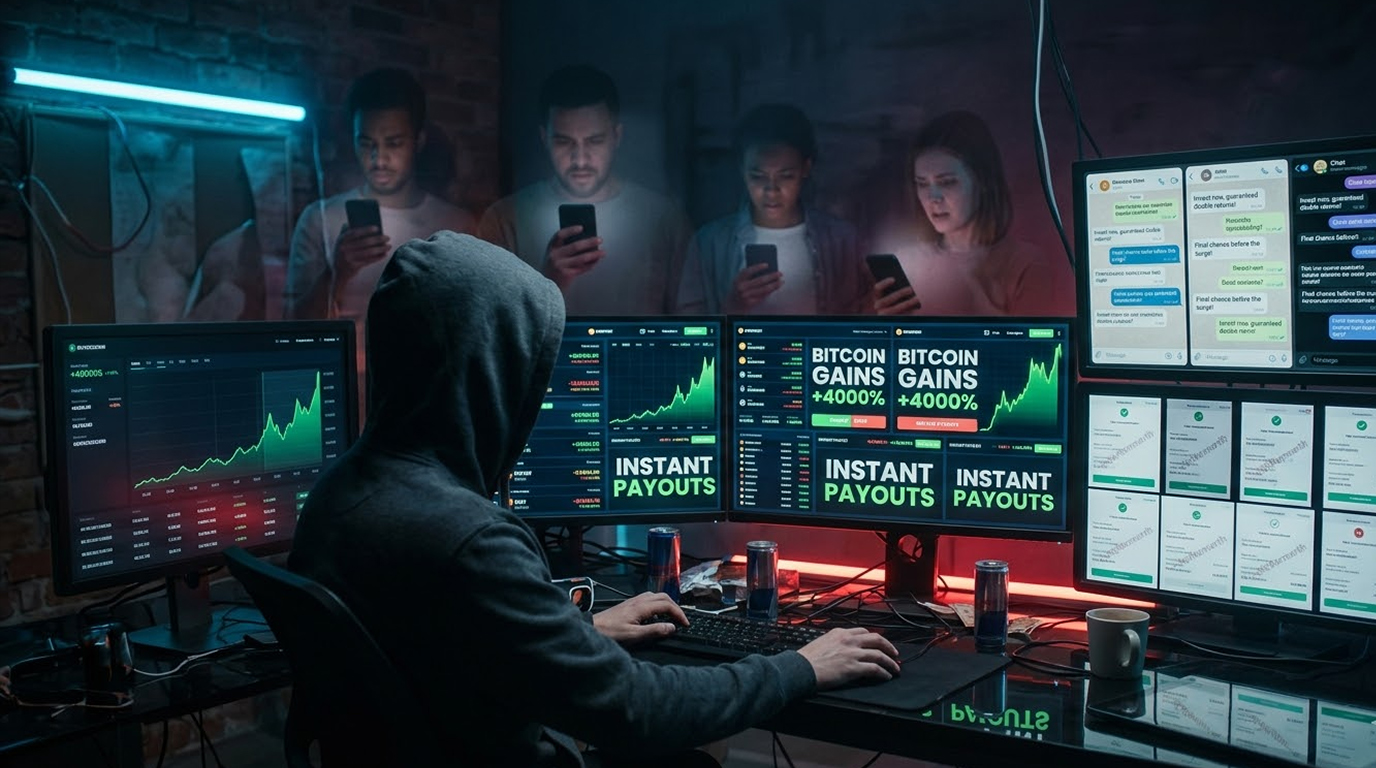
Pig butchering scammers love showing “proof” of profits. They send screenshots of fake trading dashboards (Binance, Bybit, OKX, etc.) showing huge gains, “I made $47,000 this week, you can too!” Most victims fall for it because the screenshots look professional.
Here’s a practical, no-nonsense guide to spot fake profit screenshots in seconds.
Easy Ways to Spot a Fake Trading Account in Less than Ten Seconds:
1. Look at the account balance for realism
a) Real trading accounts are not usually displayed as rounded numbers (e.g. $50,000.00). In fact, numbers tend to be displayed with irregular cents (e.g. $47,832.45).
b) Fake screenshots often display nicely rounded psychological numbers (e.g. $50,000.00 or $124,567.89).
c) When viewing an account balance, look closely at the number of decimal points and they will not be typically displayed with random cents.
2. Check the Chart and Candles for Natural Irregularities
a) Real trading charts contain lots of irregularities and have candle sizes that vary from day to day.
b) Fake trading screenshots tend to show smooth upward trending lines on the charts with evenly spaced large green candles.
c) You can tell whether an account is real or fake by zooming in; if each of the candles looks almost identical in size and shape, the account is probably not real.
3. Verify Timestamp/Date
a) Many fake screenshots have identical timestamp and date across multiple photos.
b) Real-time accounts do not always have an identical timestamp.
c) Pay attention to dates; for example, you should be suspicious of any screenshot showing “tomorrow” or on weekends when trading is closed.
4. Review Order Book/Depth of Market
a) Real Trading accounts will have true market depth (availability) and will have true bid/ask sizes (amounts offered).
b) Fake trading account will have the same size offer or perfectly symmetrical offer throughout the entire depth of market supply.
5. Identify Unknown Copy-Pasted Items
a) Search for visual content that has been copied and pasted multiple times.
b) When comparing identical visual representations, be mindful that multiple screenshots may exist that are very similar, but not identical (such as the same font, watermark on the chart, or a glitch in the UI).
6. Confirm both the asset and the pair
a) Fraudsters usually post extremely profitable trades based on unclear tokens (little volume) with very little resemblance to how the actual market has been ranging on a given day for that pair.
b) Compare the alleged profits with real market data for that pair for a given date to see if they match.
Free Verification Tools For Quick Assessments
1. Forensically.com allows users to upload screenshots and check for any cloning, edit and or removal of metadata.
2. FotoForensics.com is good for conducting ELA (Error Level Analysis) to find areas of editing.
3. Perform a Google reverse image search by uploading the picture; many of the fakes are often reused from previous fraudulent schemes.
4. Real screenshots of trading accounts typically have metadata, whereas fake screenshots usually have had the metadata stripped or manufactured using either ExifTool or other online sites that display metadata information.
5. Cross-reference your claim/capture screenshots against actual historical stock/cryptocurrency charts using TradingView.com or CoinMarketCap.com.
Common Phony Screen Shots, Real Life Examples
1. "Perfect uptrend.” This indicates that it would be a chart which displays an almost perfectly straight green line going up and absolutely no red candles over a seven-day period. This isn't how the far-too-unpredictable stock market moves in reality.
2. “Balance jumps in round numbers”. A trading account goes from $5,000, to $12,450, to $28,900, or similar sized jumps, in perfectly equal increments.
3. “Completely identical User Interfaces among various accounts.” For example, a proof image shows the same watermark on every chart, the same size font, the same amount of shadow around each button, as well as other small anomalies among all the accounts.
4. “Daily ROI that just aren't possible.” For example, a trading account shows a +380% gain/loss to the US dollar in 2 business days for any major currency pair such as BTC/USDT.
Quick Way to Defend
Any time you receive an image showing the percentage of profit from Internet trading, do the following:
1. Request to see a live image showing the same date/time as the image to determine if it was taken at that date and time.
2. Request the trade history, transaction log, or similar type of document showing the trades instead of just the account balance overall.
3. Do a reverse image search immediately.
4. Cross-check the claimed profits on a real exchange chart.
If they refuse to send a fresh screenshot with visible time or get defensive, it’s almost certainly fake.
Pig butchers rely on victims trusting pretty pictures without verification. Taking 30 seconds to check can save you from losing everything.