OpenEMR CVE-2026-24849
Here's a scenario you don't want to face. A receptionist with basic login privileges, someone who only schedules appointments, clicks a link they shouldn't. Within seconds, your database credentials are exposed.
That's exactly what OpenEMR CVE-2026-24849 makes possible.
This newly disclosed vulnerability affects OpenEMR versions before 7.0.4. It allows any authenticated user, regardless of their role, to read arbitrary files from the server. And then delete them.
What Is OpenEMR?
OpenEMR is one of the most popular open-source electronic health record (EHR) systems. Hospitals, clinics, and private practices across the globe utilize this software for the management of patient data/appointments/prescriptions, and billing processes. This makes OpenEMR CVE-2026-24849 a major concern, as medical records are one of the most highly sensitive types of data a person can have stolen.
There is a security vulnerability that exists due to the lack of path validation to the requested document, and because of the lack of checking caller privileges to access the document.
The Flaw: No Path Validation, No Privilege Check
The vulnerability resides within the Fax/SMS module, more specifically within the method EtherFaxActions::disposeDoc.
The process that went wrong on the affected server consisted of:
1. Accepting a file_path parameter from the caller;.
2. Calling the PHP readfile function with the caller-supplied file_path parameter.
3. There is no path validation or sanitization
4. The method never calls authenticate() to check privileges
On a vulnerable OpenEMR server, the result is the same regardless of configuration: any logged-in user—receptionist, clinician, billing clerk—can read any file the web server user can access.
That includes:
1. (database credentials)
2. (system user accounts)
3. Application source code
4. Configuration files
5. Other patients' data
The Destructive Twist
The CVE-2026-24849 vulnerability in OpenEMR has a couple of nasty surprises. The retrieveDoc() method first gets a copy of the document in storage. Then disposeDoc() calls unlink() to delete the document from the server after it has been retrieved. Thus, it exposes data as well as deleting the original file from the server.
There's one small safeguard: if the web server user doesn't have write permission on the file's parent directory, unlink() fails. That's why security researchers recommend targeting root-owned files like (system user accounts) for testing. But in real attacks? Attackers will target files the web user can delete.
Which Versions Are Affected?
1. OpenEMR versions below 7.0.4
2. Tested and confirmed on version 7.0.2 running on an Ubuntu 22.04 server with PHP 8.1 and Apache 2.4
3. Fixed in version 7.0.4
The vulnerability has been assigned CVE-2026-24849 and CWE-22 (Improper Limitation of a Pathname to a Restricted Directory).
Who Can Exploit This?
Any authenticated user. That's the scary part.
You don't need admin privileges. You don't need special training. If someone has a valid OpenEMR login, they can exploit OpenEMR CVE-2026-24849 on your server.
To get started with this, you will need to already have some initial conditions in place:
1. OpenEMR must be running on your target machine
2. The Fax/SMS module must be enabled on your target machine
3. EtherFax must be set to be the provider of fax sent
Proof of Concept
On June 6, 2026, the security researcher “doany1” released a working exploit for the strain to attack available in OpenEMR using this methodology:
1. The attacker accesses OpenEMR on the target server and authenticates using any valid user account
2. The attacker sends an HTTP request to the OpenEMR Fax/SMS module to return a file specified by the file_path field
3. The server will read and return the contents of the specified file
4. The server then attempts to delete the file
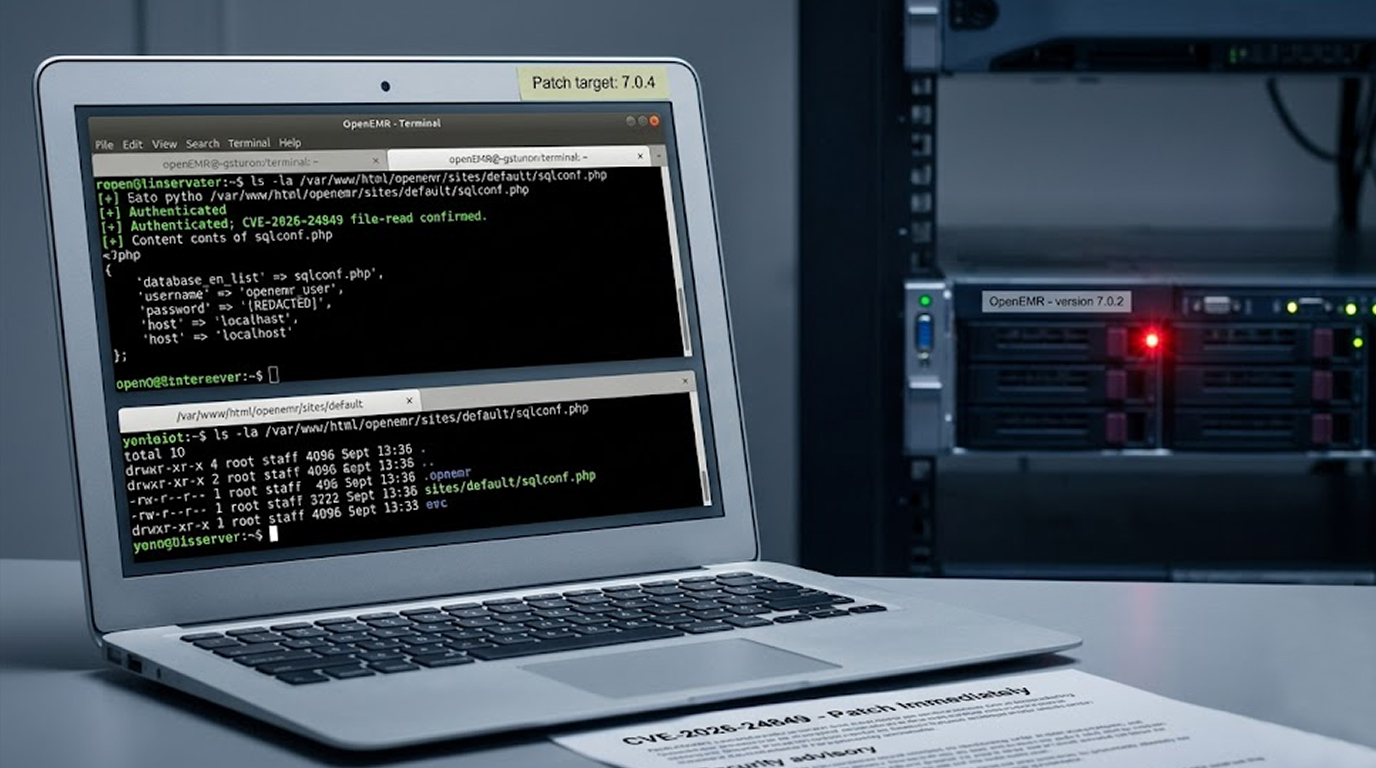
The exploit can read sqlconf.php—the file containing database credentials—effectively handing attackers the keys to your entire patient database.
Why This Matters for Healthcare
Healthcare organizations are prime ransomware targets. Medical records sell for higher prices on dark web markets than credit card data.
CVE-2026-24849 on OpenEMR gives an attacker several dependable ways to:
1. Get Database credentials that are saved onto the server
2. Get patient records that exist on the server
3. Delete Configuration Files (thereby giving them, they will cause "Downtime")
4. Move laterally through the network & other types of systems on that same network.
And because the exploit requires only a low-privilege account, attackers who compromise one weak password can immediately read your most sensitive server files.
How to Protect Your OpenEMR Server
Immediate action (today):
1. Update to OpenEMR version 7.0.4 or higher
2. The patch was released specifically to fix CVE-2026-24849
If you are unable to make an immediate update:
1. If you no longer require the Fax/SMS Module, please disable it.
2. If you are still currently using EtherFax to send/receive faxes, please check with your organization regarding possibly converting to another vendor due to EtherFax being an insecure product because of a critical vulnerability.
3. Audit all user accounts and remove all accounts that have not been used within a reasonable timeframe and any accounts that are no longer needed for business purposes.
4. Utilize strong passwords for every user and create a policy requiring multiple forms of authentication (MFA) for access to your web servers.
To ensure long-term security of server hardening, you will want to follow these tips:
1. Implement separate servers for OpenEMR; should grant minimum rights of web users based on their job functions.
2. Conduct regular checks of web user permissions for access/ability to delete sensitive documents will entail a review of permission of all directories.
3. Regularly review logs for signs of potentially suspicious activity, which may result in an unfavorable advantage being granted to FaxSMS/index.php.
4. Implement a web application firewall that denies requests targeting unsecured data files, as well as those with invalid file_path parameters (for example, requests attempting to find files in the parent directory).
The Bottom Line
OpenEMR CVE-2026-24849 is a textbook path traversal flaw with a destructive twist. It's easy to exploit, requires minimal privileges, and targets healthcare data on vulnerable servers.
The fix exists. Version 7.0.4 is available. Don't let your server be the next headline.
FAQ Section
What is CVE-2026-24849?
CVE-2026-24849 is an authenticated arbitrary file read vulnerability in OpenEMR version prior to 7.0.4. This vulnerability lies in the EtherFax module and allows every logged in user to read or delete arbitrary files from the server.
How does the OpenEMR CVE-2026-24849 exploitation work?
The exploitation vector sends a crafted Request to the Fax/SMS module in the target server with a file_path parameter that points to a specific file. The server then reads that file using the readfile() function without performing any validation, and subsequently, attempts to delete that file with the unlink() function.
What privileges would I need to exploit this vulnerability?
Any authenticated user will be able to exploit this vulnerability with no admin or special privileges required. A basic receptionist account would be more than enough.
Which files on the server are at risk?
Any file the web server user can read, including (database credentials), application source code, and configuration files.
How do I fix OpenEMR CVE-2026-24849 on my server?
Update to OpenEMR version 7.0.4 or higher immediately. If you cannot update, disable the Fax/SMS module or switch away from EtherFax as your fax provider.