detecting dns exfiltration
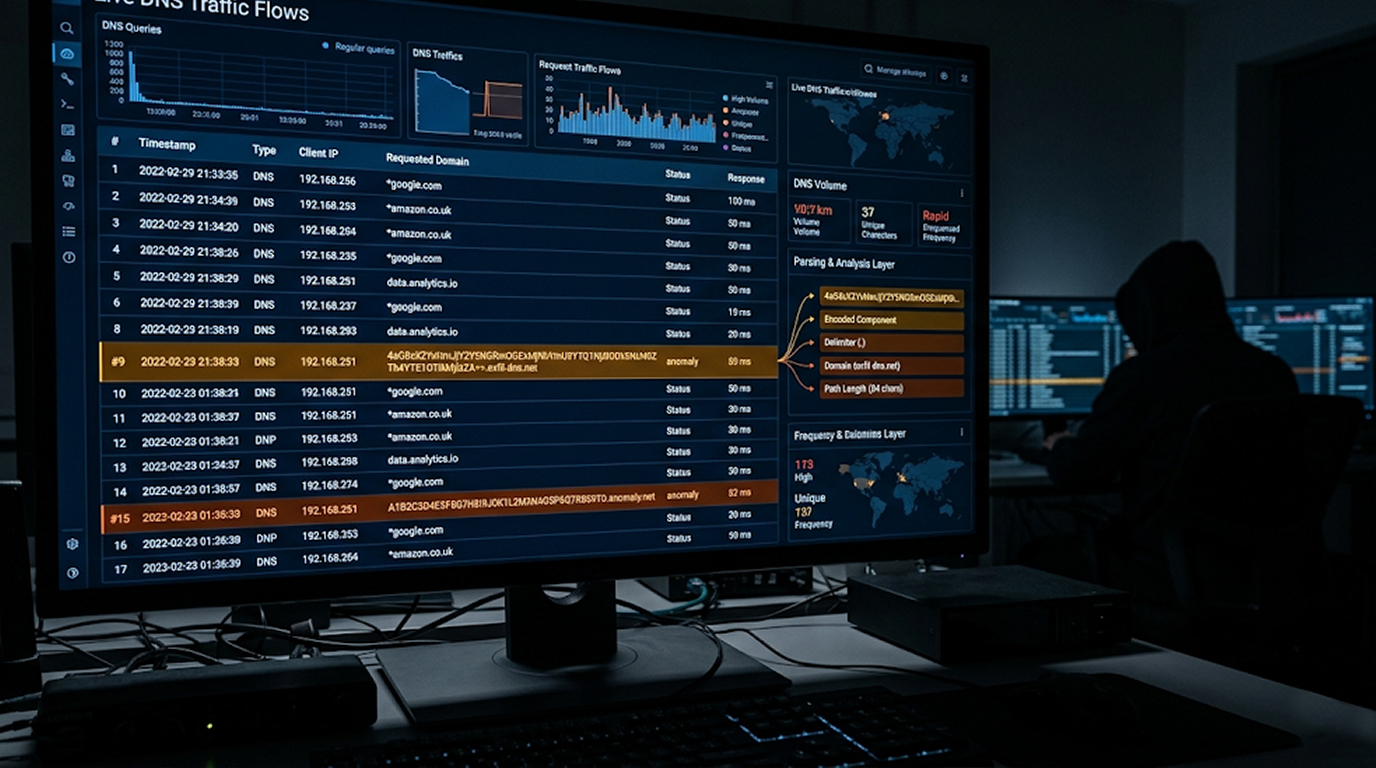
One of the most stealthy ways that attackers have been able to leak sensitive information out of a network is by conducting “DNS exfiltration.” Attackers encode stolen data into subdomain queries that appear to be simply normal DNS traffic. This allows attackers to bypass many of the traditional security measures that have been put in place to block these types of attacks.
In 2026, more and more security tools will adopt the use of memory-safe programming languages such as Rust, making it an excellent option for developing a custom DNS parser. By using a custom DNS parser built in Rust, organizations will have a fast, reliable, and safe method of inspecting DNS packets in real time.
This article gives step-by-step instructions on how to detect DNS exfiltration using a custom Rust DNS parser and provides practical code examples and detection techniques.
Why Is It Hard Detecting DNS Exfiltration?
DNS is one of the core protocols that most firewalls allow outbound traffic. Attackers use Base32, Base64, or hex to encode their data into long subdomains and then make DNS queries against their own controlled domain. The remote DNS server then decodes the subdomains back into the original data.
Some of the common indicators of DNS exfiltration are:
1. Unusually long domain names or high entropy in subdomains.
2. High volume of queries to a single and unusual domain.
3. Queries made outside of standard business hours or from places that would not normally send queries to that domain.
4. Repetitive patterns in subdomain labels.
Using a custom parser gives an organization the ability to examine raw packets in great detail instead of relying solely on high-level logs.
Utilizing Rust To Develop A DNS Parser
Through the development of custom DNS parsers utilizing the Rust programming language, we can build an enhanced parser that may give us the means to flag any suspicious DNS queries made by a user, while also eliminating the need to have any large package dependencies that could bloat the size of our parser.
A DNS Parser can be implemented in conjunction with:
1. Network taps/packet capture utilities
2. Endpoint monitoring agents
3. SIEM enrichment data pipelines
4. Custom (intrusion detection/prevention) IDS/IPS detection rules
Creating a Custom Parser in Rust
In this example we will develop a simple DNS query parser that will be capable of extracting the domain name from a DNS query via UDP (User Datagram Protocol) and identifying whether or not that query appears to be suspicious; (that is whether or not our the parsed data would fall under a detection rule indicating potential exfiltration of data).
To start, we need to add the following dependency to our Cargo.toml file:
[dependencies]
bytes = "1.0"
Below is an example of how to implement a custom DNS parser for the purpose of identifying suspicious DNS queries:
use bytes::Bytes;
use std::net::UdpSocket;
use std::str;
fn parse_dns_query(packet: &[u8]) -> Option<(String, usize)> {
if packet.len() < 12 {
return None; // Too short for DNS header
}
let mut offset = 12; // Skip DNS header (Transaction ID + Flags + Counts)
let mut domain = String::new();
while offset < packet.len() {
let length = packet[offset] as usize;
if length == 0 {
break; // End of domain name
}
if offset + length + 1 > packet.len() {
return None;
}
let label = &packet[offset + 1..offset + 1 + length];
if !domain.is_empty() {
domain.push('.');
}
domain.push_str(str::from_utf8(label).unwrap_or(""));
offset += length + 1;
}
// Return domain and estimated query size for entropy checks
Some((domain, packet.len()))
}
fn is_suspicious_exfiltration(domain: &str, packet_size: usize) -> bool {
let labels: Vec<&str> = domain.split('.').collect();
// Flag very long domains or many subdomains
if domain.len() > 200 || labels.len() > 8 {
return true;
}
// High entropy check (simple version - many encoded characters)
let entropy_score = domain.chars().filter(|c| c.is_ascii_alphanumeric()).count() as f32 / domain.len() as f32;
if entropy_score > 0.85 && packet_size > 100 {
return true;
}
// Unusual TLD or single high-volume domain patterns can be added here
false
}
fn main() {
let socket = UdpSocket::bind("0.0.0.0:53").expect("Failed to bind to port 53");
println!("Custom DNS parser listening for potential exfiltration...");
let mut buf = [0; 512];
loop {
match socket.recv_from(&mut buf) {
Ok((size, src)) => {
if let Some((domain, _)) = parse_dns_query(&buf[0..size]) {
if is_suspicious_exfiltration(&domain, size) {
println!("[ALERT] Potential DNS exfiltration from {}: {}", src, domain);
// Log, alert, or block here
} else {
println!("Normal query: {}", domain);
}
}
}
Err(e) => eprintln!("Error receiving packet: {}", e),
}
}
}
This basic parser is used for parsing DNS queries to find out the QNAME (domain) and use simple heuristic methods for the purpose of detection.
Advanced Detection Techniques in Your Rust Parser
1. Measure Shannon Entropy : Calculate Shannon Entropy on the amount of actual entropy present in subdomain labels, which indicates how much information is encoded.
2. Keep an eye on the number of queries sent in one-second periods per domain and record any unusual spikes or dips that you see in terms of query volume.
3. The length of the labels in the subdomains will be very large and the frequency of the same length will be constant; this indicates that subdomain labels may be used to extract information.
4. On the basis of the initial characters of the encoded string (for example, Base32) and the typical characters that precede them, you can identify a prefix that is common to all encodings.
5. Baseline Behavior : Compare the level of activity to expected activities based upon average behavior of traffic in regards to that host/network segment.
For production use, combine with libraries such as hickory-proto (formerly trust-dns) for full DNS protocol support while still using your own logic for the heuristics of exfiltration.
Real-World Integration Ideas
1. Use a mirrored copy or duplicate of a network port (e.g. SPAN session) as input to run the parser.
2. Integrate the parser into an eBPF-based solution to perform inspections at the kernel level while consuming as few resources as possible to increase efficiency in your overall system.
3. Feed the alerting generated by the parser into your SIEM systems or other automation you have to create action in response to an alert via a playbook.
4. Use machine learning models to learn and adapt to normal DNS activity for each variable environment.
Limitations and Best Practices
A single parser won’t catch everything. DNS exfiltration can be low-and-slow or use encryption/obfuscation. Therefore, you need to layer your security controls:
1. Utilize egress filtering to only allow network traffic from trusted DNS server resolvers.
2. Implementing DNS sinkholing or RPZ.
3. Utilize behavioral analytics for analyzing query request patterns.
4. Utilizing endpoint detection capabilities to identify unusual DNS process activity on endpoints.
Ensure you are testing your parser in a lab environment first with a combination of experimental solutions such as dnscat2 or another bespoke written exfiltration client prior to deploying it in production.
Conclusion
Creating a custom Rust parser for enabling detection of DNS exfiltration provides security teams with a clean, clear view & control over one of the most frequently ignored protocols. With its high speed/performance and high quality/safety of the Rust programming language; building trusted and scalable network security applications will be very easy to perform in the year 2026 using Rust.
Using these code examples above as examples only, and further replace these examples with additional validations around entropy, rate limits thresholds, and transition into your existing monitoring system, based upon proper examination of standard and non-standard DNS request traffic patterns, will give security teams an opportunity to detect and shut down any possible hidden data leakages before success.
To maintain your network's security, take a proactive approach to developing, testing and evolving your custom parser repeatedly and on an ongoing basis.
FAQ Section
Q1: What is DNS exfiltration?
Exfiltration via DNS (Domain Name System) is a method a hacker can use to transfer data that would otherwise not be allowed out of the target network. This is accomplished by wrapping the data to be exfiltrated in a DNS query to a DNS server that they control and sending the query across the target network to this server. This method allows an attacker to bypass virtually all firewalls and detection systems.
Q2: Why Rust for a custom DNS parser?
Because of its advantages regarding memory safety, high packet-processing performance, and zero-cost abstractions, Rust is an excellent programming language for creating any kind of security-critical networking tool, avoiding the risks of using C/C++.
Q3: How does a custom Rust parser detect exfiltration?
Your custom Rust parser inspects the raw DNS packet contents for any of the following indicators of potential DNS exfiltration: very long domain names; high-entropy subdomain names; a lot of queries to largely unknown domains; and encoded data appearing in a repetitive pattern.
Q4: Can I replace commercial DNS security solutions with my parser?
No, your parser is intended to be a specific and customizable component that should be employed alongside more robust, commercially available, DNS security solutions, behavioral analytics solutions, and robust network controls.
Q5: Where can I safely test a DNS exfiltration detection parser?
An isolated lab environment, such as one where dnscat2 or a custom test client is used, is the most appropriate place to test your parser. Under no circumstances should you ever test a parser in a production network without appropriate clearance.