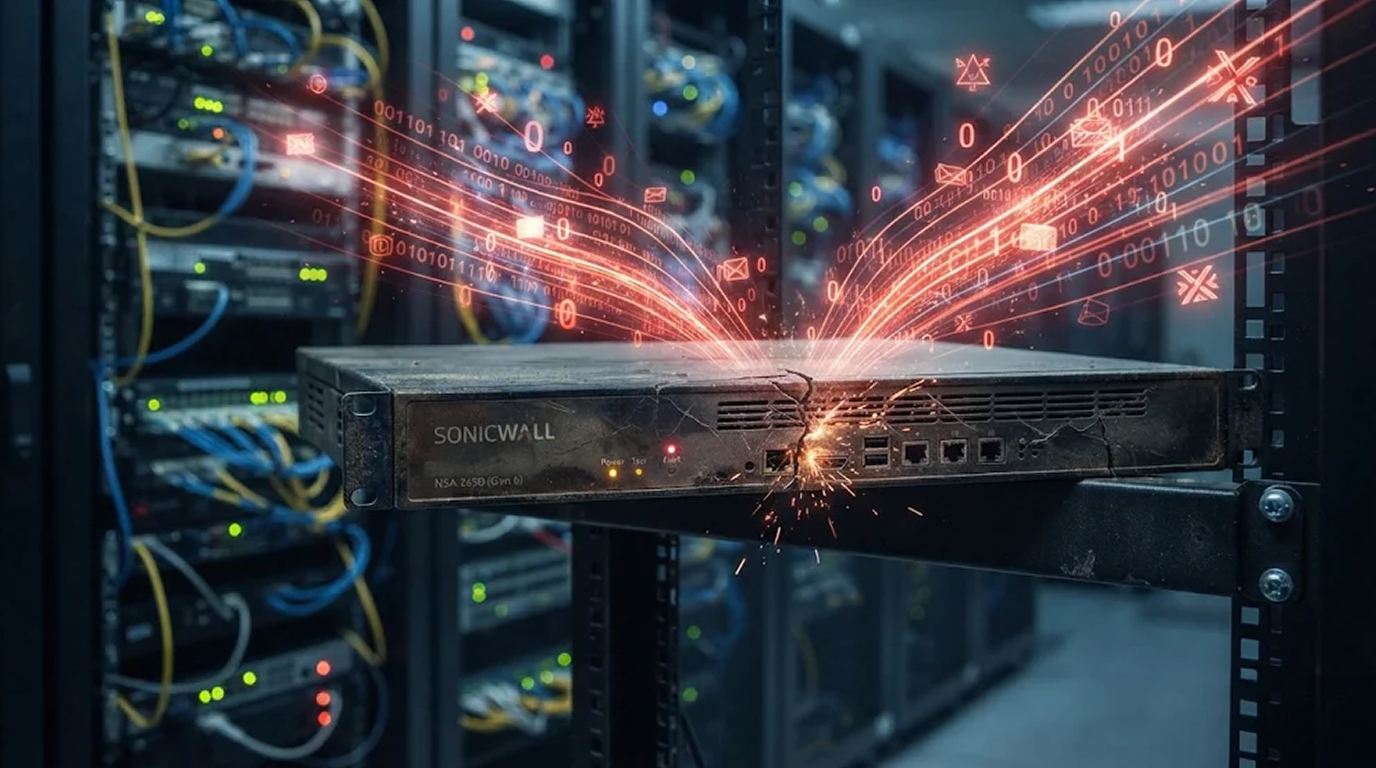
SonicWall published a message this week that reads less like a product announcement and more like a liability notice.
All customers still running Generation 6 firewalls should retire and replace them immediately, and stop exposing them on the internet edge.
The company's reasoning is explicit. Attackers now use automation and AI to find and exploit unsupported edge devices faster than ever. SonicWall expects internet-facing Gen 6 firewalls to be actively targeted, and says any unit still in service should be treated as a high-risk exposure.
The recommended path is migration to a Gen 8 firewall running SonicOS 8.
Why This Is Different From a Normal End-of-Life Notice
Vendors retire products constantly. What makes this one worth acting on is the data SonicWall cites alongside it.
Google Mandiant's M-Trends report, published in March 2026, found that mean time to exploit has gone negative. The estimate is -7 days.
Read that carefully. It means exploitation, on average, begins before a patch is available.
The trajectory is what matters.
|
Year |
Mean Time to Exploit |
|
2018 |
63 days |
|
2024 |
-1 day |
|
2026 |
-7 days |
That is not a gradual improvement in attacker efficiency. It is a change in the order of operations. The attacker is no longer waiting for defenders to be told what to fix.
And Gen 6 devices are in the worst possible position in that environment, because there is no patch coming at all. The flaw does not need to be discovered before a fix. It needs to be discovered at any point, ever.
Why Edge Devices Specifically
Mandiant's explanation is worth quoting. Threat actors' interest in security appliances and networking infrastructure is compounded by what those assets do. They provide critical inspection of data ingress and egress points, which grants significant visibility and permissions to whoever gains access.
Cisco Talos' 2025 Year in Review adds a number to that. Twenty-three percent of CVEs discovered that year directly impact network devices, including VPN appliances, next-generation firewalls, load balancers, and routers.
Talos's reasoning lines up with the CISA KEV data. These systems sit at the perimeter, they are internet-facing, they often lag in patching, and once compromised they provide direct operational leverage.
A Gen 6 firewall that stopped receiving patches occupies every one of those conditions at once.
The Affected Products
The devices running SonicOS 6.x, as listed by SonicWall:
- SOHO and small business: SOHO, SOHO W, SOHO 250, SOHO 250W, TZ300, TZ300W, TZ300P, TZ350, TZ350W, TZ400, TZ400W, TZ500, TZ500W, TZ600, TZ600P
- NSA and NSa series: NSA 2600, NSA 3600, NSA 4600, NSA 5600, NSA 6600, NSa 2650, NSa 3650, NSa 4650, NSa 5650, NSa 6650, NSa 9250, NSa 9450, NSa 9650
- SuperMassive: 9200, 9400, 9600, 9800
- NSsp: 12400, 12800
- Virtual: NSv 10 through NSv 1600 (Gen 6 virtual)
The source lists these with some inconsistent capitalization across the NSA and NSa families. Verify your exact model against SonicWall's own documentation rather than against any secondary list, including this one.
What to Do, in Order
SonicWall's guidance is sequential and does not leave much room for interpretation.
- Inventory every Gen 6 firewall in production. Every one. Including the ones in branch offices that nobody has logged into since the last office move.
- Prioritize internet-exposed units first. Anything with a WAN interface, anything providing remote access, anything reachable from outside.
- Replace with a Gen 8 firewall running SonicOS 8. Not a temporary workaround, not a firmware upgrade. Replacement.
- Contact an authorized SonicWall partner to plan the migration. The lead time is the reason to start now rather than after the first incident.
The Interim Mitigations
Not every organization can replace hardware this week. SonicWall published a list for the gap.
|
Mitigation |
What It Does |
|
Disable WAN management |
Turns off HTTPS, SSH, and SNMP on WAN interfaces |
|
Disable SSL VPN, or restrict it |
Limit to known source addresses if it cannot be turned off |
|
Enforce MFA everywhere |
On every remaining remote-access and admin account |
|
Reset local passwords |
Assumes any stored credential may be compromised |
|
Disable unused services and interfaces |
Reduce the surface to what is actually needed |
|
Monitor logs closely |
Unusual logins, configuration changes, traffic patterns |
These reduce exposure. They do not fix anything, because there is nothing left to fix.
The Sentence to Remember
SonicWall's own summary is the one to put in front of whoever owns the budget conversation.
The risk to an unsupported firewall grows every day it stays online. One breach reaches everything. A compromised perimeter firewall gives attackers a foothold for credential theft, lateral movement, and ransomware deployment.
That last clause describes a sequence, not a possibility. It is the same sequence we have documented in campaign after campaign this year, where an edge device becomes the initial access point for an intrusion that ends somewhere far more sensitive.
Why the AI Framing Is Not Marketing
It would be easy to read the AI language in SonicWall's notice as positioning. The Mandiant data argues otherwise.
If exploitation on average precedes the patch, then the constraint on attackers is no longer tooling or skill. It is discovery. They need to find exposed instances before someone else does, and automation is how that happens at scale.
An unsupported device does not need a new vulnerability. It needs any vulnerability. And AI-assisted scanning is very good at matching known issues against a large population of internet-facing hosts.
What This Means Beyond SonicWall
The Gen 6 situation is a specific case of a general problem. Every organization has some category of hardware that works fine, does its job, and stopped receiving security updates years ago.
The difference here is that SonicWall is telling customers directly, and the data supports the urgency. Most end-of-life situations do not come with a vendor statement that says treat this as a high-risk exposure.
If you have a Gen 6 unit in production, it is now a known-unsupported, internet-facing appliance with a vendor warning attached to it. That is about as clear a signal as an infrastructure team is going to get.
FAQ
What is SonicWall asking customers to do?
Retire and replace all Generation 6 firewalls immediately, and stop exposing them on the internet edge. The recommended replacement is a Gen 8 firewall running SonicOS 8.
Why now?
Because attackers use automation and AI to find and exploit unsupported edge devices faster than before. SonicWall says it expects internet-facing Gen 6 firewalls to be actively targeted.
Are Gen 6 firewalls still receiving patches?
No. Gen 6 is no longer actively supported and does not receive patches, including for critical flaws.
What does "negative mean time to exploit" mean?
Google Mandiant's M-Trends report estimates mean time to exploit at -7 days, meaning exploitation on average begins before a patch is available. It was 63 days in 2018 and -1 day in 2024.
Which models are affected?
SonicOS 6.x devices across SOHO, TZ, NSA and NSa, SuperMassive, NSsp, and NSv Gen 6 virtual series. Verify your exact model against SonicWall's documentation.
What should I do if I cannot replace the hardware immediately?
Disable WAN management including HTTPS, SSH, and SNMP on WAN interfaces. Disable SSL VPN or restrict it to known source addresses. Enforce MFA on every remote-access and admin account. Reset local passwords. Disable unused services and interfaces. Monitor logs for unusual logins, configuration changes, and traffic.
Why are edge devices targeted so heavily?
Because they sit at the perimeter, they are internet-facing, they often lag in patching, and once compromised they provide direct operational leverage. Cisco Talos found 23% of CVEs discovered in 2025 directly impact network devices.
Does a firewall compromise stay contained?
No. SonicWall's own description is that one breach reaches everything. A compromised perimeter firewall gives attackers a foothold for credential theft, lateral movement, and ransomware deployment.
Is this a marketing push?
The Mandiant and Talos data cited alongside it is independent and supports the urgency. The negative time to exploit figure is the strongest argument in the notice.
What is the first practical step?
Inventory every Gen 6 unit in production, then prioritize the ones exposed to the internet or providing remote access.
How long does migration take?
That depends on your partner and your supply chain. It is also the reason SonicWall says to contact an authorized partner now rather than after an incident.