For decades, security professionals clung to a comforting belief: the air gap would save them.
If your critical systems were not connected to the internet, they were safe. No cables.
No network. No compromise. It made sense. It felt right.
That belief is now dangerously obsolete.
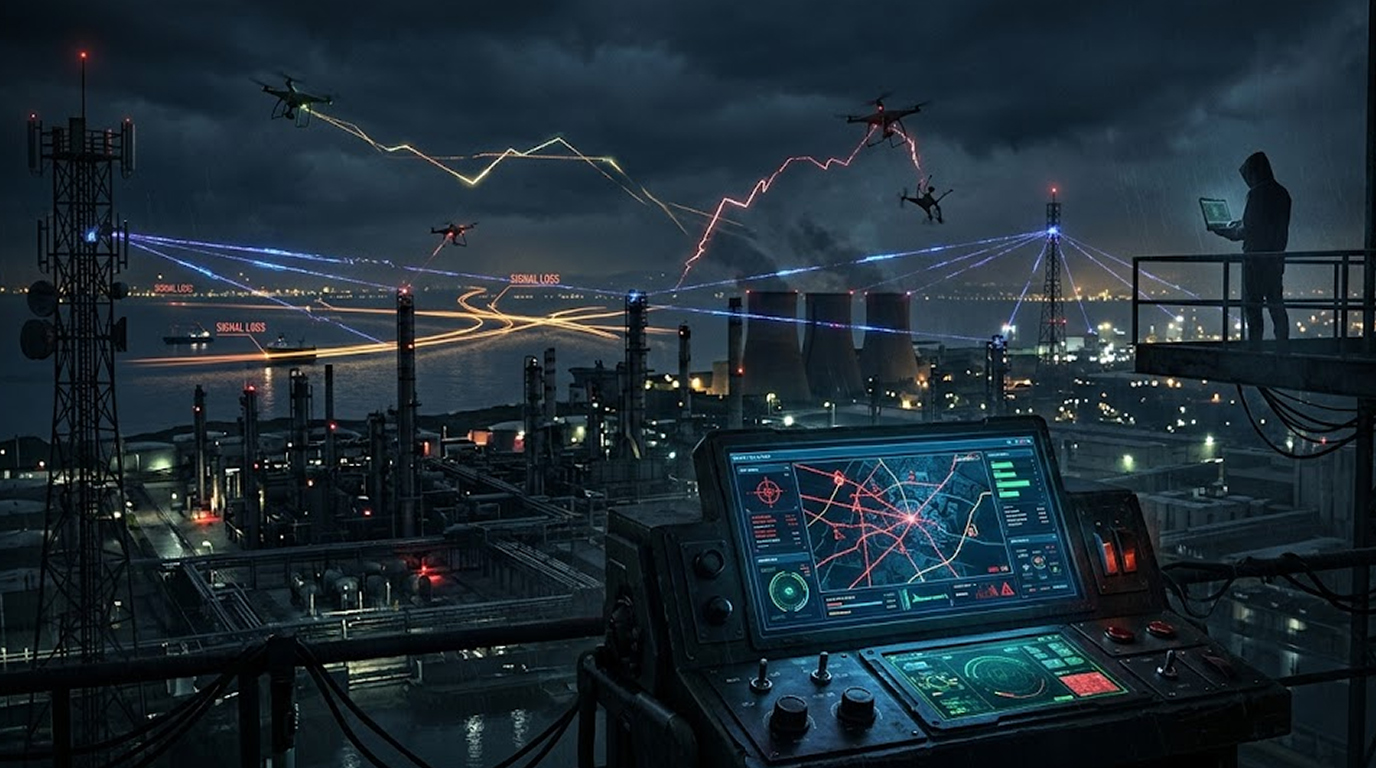
We have entered the era of cyber-physical disruption. Attackers no longer need to hack your network to destroy your infrastructure. They can spoof your GPS, drop drones on your facility, or compromise the supply chain before your equipment ever arrives.
The air gap never really existed. We just did not know where the bridges were.
Let me show you what has changed and why every security leader needs to rethink their assumptions.
What Is Cyber-Physical Disruption?
Cyber-physical disruption is exactly what it sounds like: attacks that cross from the digital world into the physical world.
Traditional cyber attacks steal data or encrypt files. Cyber-physical attacks crash trains, shut down power grids, poison water supplies, or collide ships.
The key difference:
|
Traditional Cyber Attack |
Cyber-Physical Disruption |
|
Targets data |
Targets physical systems |
|
Consequences are financial |
Consequences can be fatal |
|
Recovery involves restoring backups |
Recovery involves rebuilding infrastructure |
|
Attackers need network access |
Attackers need effect, not access |
The most dangerous part? Cyber-physical attacks often bypass traditional security controls completely. Your firewall does not stop a drone. Your EDR does not detect GPS spoofing. Your air gap does not matter if the attacker never touches your network.
GPS Spoofing: The Attack You Cannot See
GPS spoofing is exactly what it sounds like. An attacker broadcasts fake GPS signals that are stronger than the real satellites. Receivers believe the fake signals and report wrong positions, times, or both.
Unlike GPS jamming (which simply blocks signals), spoofing is stealthy. The system appears to work normally. It just reports wrong information.
How GPS Spoofing Actually Works
A GPS receiver calculates its position by measuring the time it takes for signals to arrive from multiple satellites. The receiver knows exactly when the signals were sent. It knows the speed of light. It calculates distance.
A spoofer transmits fake signals that are slightly stronger than the real satellites. The receiver locks onto the fake signals instead. The attacker controls the timing. The attacker controls the reported position.
What this means in practice:
1. A ship's navigation system shows the wrong location
2. A drone's autopilot flies to the wrong coordinates
3. A power grid's time synchronization drifts out of phase
4. A financial trading system's timestamps become unreliable
Real-World GPS Spoofing Incidents
Commercial Shipping Disruptions:
Multiple commercial ships in major waterways have reported GPS readings showing they were at airports several miles inland. Navigation systems failed. Some ships drifted off course. Investigators traced the interference to shore-based transmitters. The ships were never boarded. The attacker never touched their networks. They just controlled the sky.
Port Navigation Anomalies:
Container ships entering major global ports have reported persistent GPS spoofing lasting for years. Readings show positions shifting by hundreds of meters. The spoofing appears to be a side effect of broader electronic warfare operations. Collateral damage, not targeted attack. The impact remains unchanged; ships have lost faith in their navigational systems.
Significant Disruption of Electrical Power Infrastructure (Theoretical, Now Probable):
Numerous critical infrastructures depend upon GPS for time synchronization. Substations, Supervisory Control And Data Acquisition (SCADA) systems as well as backup generating stations use GPS timing to execute all operations. A successful spoofing attack against GPS could delay time by milliseconds, resulting in phase shifts, tripping protective relays and cascading failures across the electric grid. No breach of the computer network would be required.
What GPS Spoofing Means for Your Organization
You do not need to run a shipping company to worry about GPS spoofing.
Ask yourself:
1. Do you currently operate any GPS-based systems operating solely off GPS-related timing information to maintain correct time and synchronize your digital systems?
2. Do you use any types of backup timing sources besides GPS (e.g., atomic clock, authenticated network time protocol)?
3. Are any of your field-based assets (vehicles, drones, mobile sensors) using GPS for navigation purposes?
4. Have you tested how your equipment functions if GPS is not only unavailable but also reporting inaccurate values?
Immediate implementation steps:
1. Install and utilize reliable timing sources (example: precision time protocol with authentication; holdover oscillators)
2. Monitor for any anomalies in the accuracy and precision of GPS signals reported on your system (example: any unexpected jumps in a reported location).
3. Provide training to physical operations personnel regarding possible indicators indicating GPS or other signals may be spoofed (example: several physical locations being reported by different receivers).
Drone Strikes on Critical Infrastructure
Drones are cheap. Drones are accessible. Drones can carry payloads.
This combination changes everything about physical security.
Why Drones Are the Perfect Cyber-Physical Weapon
Low cost, high impact:
A commercial drone costs a few thousand dollars. A swarm of 50 drones costs less than a single penetration test. The potential damage? Millions or billions.
Bypasses traditional security:
Your perimeter fence does not stop a drone. Your guards do not see a drone at night. Your cameras may not track a drone flying at altitude. The attacker never steps onto your property.
Difficult to attribute:
Who launched the drone? Where did they launch from? Was it a nation-state, a criminal group, or a lone actor? Answers are rarely clear. Attribution takes weeks or months.
Confirmed Drone Attacks on Critical Infrastructure
Nuclear Power Facilities:
Major nuclear power plants have been repeatedly targeted by drone strikes. Drones have struck training buildings, cargo areas, and reactor containment structures. Radiation levels remained normal in reported incidents, but the message was clear: nuclear facilities are not safe from aerial attack.
Energy Refineries:
Long-range drone strikes have repeatedly hit energy refineries deep inside sovereign territory. Drones travel hundreds of kilometers. They strike with precision. They cause fires, shutdowns, and economic damage. The air gap between the refinery network and the internet never mattered. The attack came from above.
Electrical Substations:
Unknown actors have repeatedly attacked electrical substations with firearms and, in at least one case, a drone. In one major incident, tens of thousands of people lost power for days after attackers shot two substations. Drones make these attacks easier, safer for the attacker, and harder to stop.
What Drone Attacks Mean for Physical Security
Your physical security program was designed for ground-based attackers. Drones invalidate most of those assumptions.
Perimeter security is no longer sufficient:
A fence, gate, and guard post stop a car. They do not stop a drone flying over at 200 feet.
Cameras have blind spots:
Most security cameras point at ground level. They do not look up. Drones can fly through these blind spots undetected.
Response times are too slow:
By the time your security team sees a drone, it has already dropped its payload. Seconds matter. Traditional response takes minutes.
Immediate actions for physical security teams:
1. Conduct a drone-specific vulnerability assessment (fly a drone over your facility and see what your cameras catch)
2. Install drone detection systems (RF sensors, acoustic sensors, radar for critical facilities)
3. Train security personnel on drone response (observation, reporting, coordination with law enforcement)
4. Consider physical barriers for critical assets (nets, covers, hardened roofs)
The Death of the Air Gap: Why Isolation Failed
The air gap was a beautiful theory. Take critical systems. Disconnect them from all networks. No internet. No corporate network. No wireless. Physically isolated.
Safe. Right?
Wrong.
Three Ways Attackers Cross the Air Gap
1. The Supply Chain Attack
Your air-gapped system receives software updates. Where do those updates come from? A vendor. On a USB drive. Carried by a technician who also works on connected systems.
The attacker compromises the vendor. The vendor signs malware as an update. The technician brings the USB drive to your air-gapped facility. The update installs. The air gap never existed.
Real example: The Stuxnet worm that destroyed industrial centrifuges crossed the air gap via USB drives. No network connection required.
2. The Insider Threat
Your employees have access to the air-gapped facility. One of them brings a smartphone inside. The smartphone has mobile data. The air gap just developed a bridge.
Insiders do not need to be malicious. A contractor checking personal email. A technician using a hotspot for remote support. A manager taking a photo of a control panel. All create bridges.
3. The Side Channel Attack
This is the most sophisticated method. Attackers do not need a direct connection. Ways to exfiltrate data include:
1. Acoustic signals: Fans, hard drives, and power supplies emit sound. Modulate that sound with data. Record it with a phone outside the building.
2. Electromagnetic emissions: Every electronic device emits radio frequency energy. Modulate that energy with data. Receive it from a drone flying overhead.
3. Thermal signals: Devices generate heat. Data can be encoded in temperature variations. Read them with a thermal camera through a window.
These sound like science fiction. They are not. They have been demonstrated in research labs and in the wild.
What the Death of the Air Gap Means for You
Stop assuming air-gapped systems are safe. They are not. They are just harder to attack.
Actions for air-gapped environments:
1. Assume compromise. Design air-gapped systems with defense in depth, not just isolation.
2. Control all inbound media. USB drives, CDs, laptops, phones. Scan everything. Consider write-once media.
3. Monitor for side channels. Look for unexpected electromagnetic or acoustic emissions.
4. Limit human access. The more people enter the air-gapped space, the more bridges you create.
5. Test your air gap. Hire a red team to try to cross it. You will be surprised what they find.
The Convergence: GPS Spoofing + Drones + Air Gap Bypass
All together, the most deadly attacks combine all three techniques.
Scenario: A coordinated cyber-physical attack against a power substation.
Step 1: Reconnaissance
Attackers use commercial drones to map the substation, determine camera blind spots, identify guard patrols, and locate critical transformers.
Step 2: Supply chain compromise
Attackers compromise a vendor supplying protective relay firmware and inject a signed malware payload using the vendor’s certificate.
Step 3: Air gap crossing
A technician arrives at the substation to install the firmware update. After the malware has been installed, an air-gapped control system is infected by them.
Step 4: GPS Spoofing
The attackers will periodically spoof GPS signals over an area causing the substation to become unsynchronized and therefore the protective relay will not be correctly coordinated. This will lead to a destabilization of the grid.
Step 5: Drone Strike
Small drones drop incendiary devices on transformers that the malware has already disabled. Fires spread. Manual override fails. The substation is destroyed.
Step 6: Attribution Confusion
Was it nation-state aggression? Cybercriminals? A lone actor? Investigators find evidence of all three. No clear answer emerges.
This scenario is not hypothetical. Every component has been demonstrated in the wild. Only the coordination is missing. It will not stay missing.
What Security Leaders Must Do Now
The era of cyber-physical disruption requires new thinking, not just new tools.
Shift Your Mindset
From "Can we prevent?" to "How do we survive?"
Cyber-physical attacks are asymmetric. The attacker only needs to succeed once. You need to succeed every time. Prevention will fail. Focus on detection, response, and recovery.
From "Our air gap protects us" to "Our air gap is one layer"
Air gaps slow attackers down. They do not stop them. Build additional controls behind the gap.
From "Physical and cyber are separate" to "Converged risk management"
Your physical security team and your cyber security team need to talk. They need to plan together. They need to respond together.
Take Specific Actions
For GPS reliance:
1. Inventory all systems using GPS for timing or positioning
2. Implement authenticated time sources (PTP with profile, NTS)
3. Deploy GPS anomaly detection
4. Train operators to recognize and respond to spoofing
For drone threats:
1. Conduct drone-specific security assessments
2. Deploy drone detection for critical facilities (RF, radar, acoustic)
3. Coordinate with local law enforcement on drone response
4. Harden critical assets against aerial attack
For air gap realities:
1. Assume air-gapped systems are reachable
2. Strictly monitor and scan all incoming media;
3. Audit and restrict all human access;
4. Use dedicated red team exercises to test your air-gapped
For cyber-physical resilience:
1. Conduct tabletop exercises for physical impact scenarios (power loss, GPS loss, facility damage)
2. Develop recovery procedures that do not rely on the systems being attacked
3. Build redundancies into critical physical processes
4. Engage with threat intelligence sharing groups
Conclusion: The Air Gap Never Existed
We told ourselves a comforting story. Disconnect critical systems. They will be safe. Attackers cannot reach them.
The story was always fiction.
Stuxnet crossed the air gap on a USB drive. GPS spoofing reaches systems without touching any network. Drones attack from the sky, bypassing every fence and guard.
Cyber-physical disruption is here. GPS spoofing is real. Drone strikes on infrastructure are confirmed. The air gap is dead.
The question is not whether you will face these threats. The question is whether you will be ready when you do.
Stop assuming isolation protects you. Start building resilience for a world where the physical and digital are one.
FAQ Section
1. What is the difference between GPS jamming and GPS spoofing?
GPS jamming blocks GPS signals entirely. The receiver knows it has lost signal. GPS spoofing broadcasts fake signals that appear real. The receiver reports wrong information but thinks everything is normal. Spoofing is much more dangerous because operators do not know they are being deceived.
2. Can drones really bypass air gap security?
Yes. Drones do not need network access. They attack physically. A drone can drop an incendiary device on a transformer, spray corrosive material on exposed equipment, or drop a USB drive wired into the facility network. The air gap protects against network attacks. It does not protect against aerial attacks.
3. Is my organization at risk of GPS spoofing?
If any of your systems rely on GPS for timing or navigation, yes. This includes financial trading systems, power grid synchronization, telecommunications, fleet management, and drone operations. Even if your primary timing comes from other sources, backup systems often fall back to GPS.
4. How do I know if my facility is vulnerable to drone attacks?
Conduct a drone vulnerability assessment. Fly a commercial drone around and over your facility. Note where it is detected and where it is not. Check if cameras track it. Check if guards notice it. You will likely find significant gaps in detection and response.
5. What is the single most important action against cyber-physical disruption?
Assume your air gap is not an air gap. Build defense in depth behind it. Control all inbound media and people. Monitor for side channels. And most importantly, build recovery capability that does not rely on the systems being attacked. Resilience, not prevention, is your survival strategy.