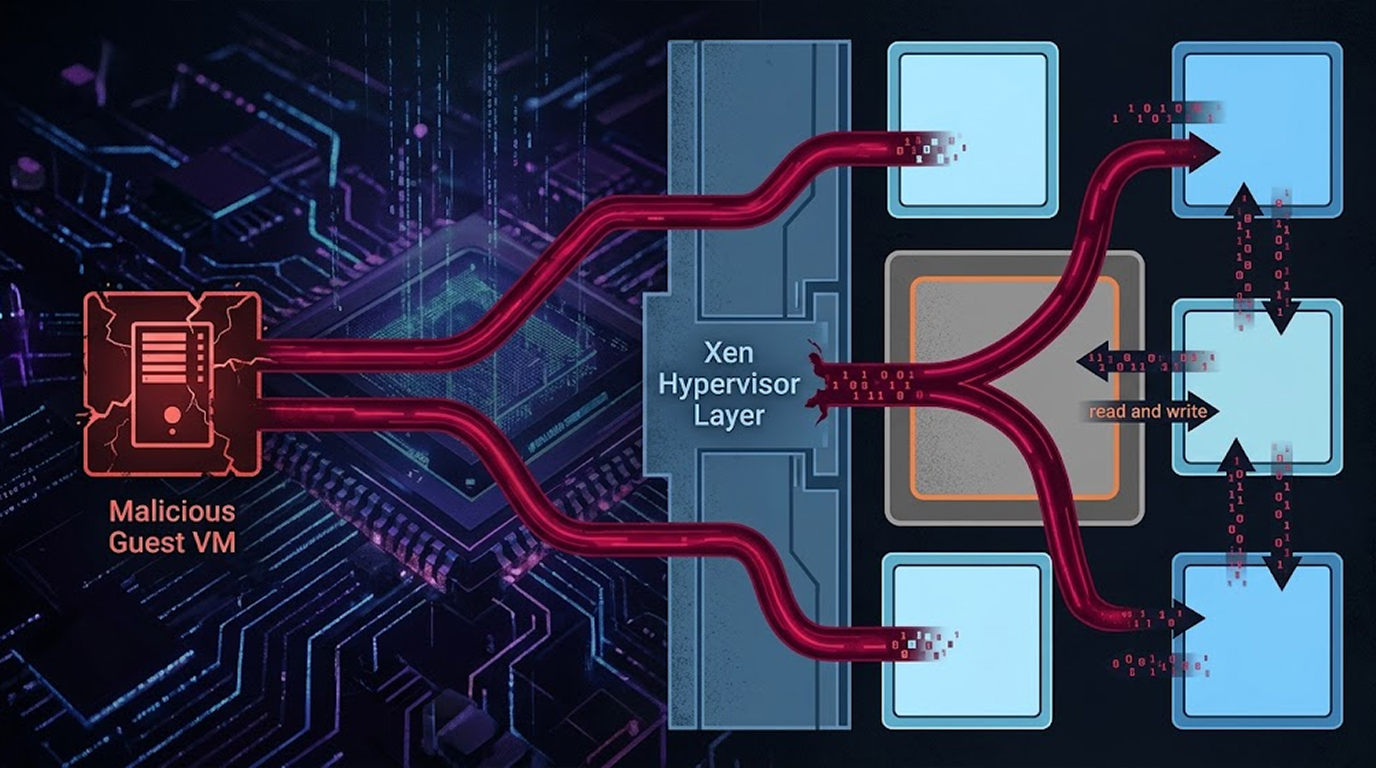
Two flaws in the Xen hypervisor allow a malicious guest virtual machine to read and write the memory of other VMs on the same host. That includes dom0, the management VM that by default holds full permissions over everything else.
The Xen Project published an advisory on November 3. Patches exist. There is no known mitigation.
That combination is the worst kind. You either patch and restart, or you accept the risk.
The Scope
Every Xen version from 4.6 onward is vulnerable. Versions 4.5 and earlier are not.
The flaws are tracked as CVE-2026-102703 and CVE-2026-102704, grouped under Xen advisory XSA-523.
XCP-ng, the open-source virtualization platform built on Xen, described the impact in its update notes with unusual clarity. A single compromised guest can break out of its isolation and take over the whole host.
Where the Flaw Lives
The problem is in grant copy, the mechanism Xen uses to copy data between VMs. Each VM tells Xen which of its memory pages other VMs may access, and Xen checks those permissions before allowing a copy.
To save time on a batch of copies within the same memory page, Xen reuses checks it has already made. In some cases, it did not check again when it should have.
That is the entire bug. A cached permission check applied to a copy it should not have covered, and the result is memory access that crosses VM boundaries.
How It Was Found
The Xen Project credited Anthropic with finding the flaws using its Claude model. Stephan Lipp of Ada Logics then validated the finding. The CodeAnt AI Security Research Team independently reported the same issue later.
That attribution matters, because it is another data point in the ongoing question of whether AI models can find real, high-value memory safety bugs in production hypervisors. In this case, they did.
Xen's advisory does not mention any attacks exploiting the flaws, and it does not specify what access within the guest an attacker needs to trigger them.
The Patch Matrix
The patching situation is uneven, and that is where the practical difficulty begins.
|
Platform |
Status |
Action Required |
|
Xen source (unstable to 4.19.x, 4.18.x to 4.17.x) |
Patches available in the advisory |
Apply and restart |
|
Xen 4.6 to 4.16 |
No patch in the advisory |
Upgrade to a supported version |
|
XCP-ng 8.3 |
Fixed in xen-4.17.7-4.2.xcpng8.3, released Nov 3 |
Host reboot required |
|
Qubes OS 4.3 |
Fixed in Xen packages 4.19.6-3 in dom0 |
Dom0 restart required; AEM users must reseal passphrase |
|
Debian bookworm, trixie, forky |
Listed as vulnerable on Nov 4 |
Awaiting update |
|
Debian sid |
Listed as fixed |
Already patched |
Xen 4.16's security support ended on December 2, 2024. If you are running 4.16 or older, there is no patch coming. The answer is to move to a supported branch.
The Qubes OS Complication
Qubes OS is a security-focused desktop operating system that isolates software into separate Xen-based compartments called qubes. Its bulletin states that every supported release and configuration is affected.
The fix is for Qubes 4.3, the only release it still supports. Dom0 must be restarted.
There is an additional step that is easy to miss. Anti Evil Maid users must reseal their secret passphrase, because the new Xen binaries change the PCR18 and PCR19 measurements. If you skip that step, AEM will fail on next boot.
Qubes told users on November 3 to keep installing updates as normal. The fixed packages were in the security-testing repository at that point, scheduled to move to stable after community testing over roughly two weeks.
Why There Is No Workaround
Xen's advisory does not offer a mitigation. This is not a configuration problem or a feature you can disable. The grant copy path is fundamental to how VMs communicate, and the flawed check caching is inside that path.
If you cannot patch, the only real options are reducing blast radius or accepting risk.
- Isolate untrusted guests. If a VM runs untrusted code or accepts untrusted input, move it to a host where it does not share dom0 with anything sensitive.
- Reduce guest count per host. Fewer guests on a host means fewer potential attackers sharing the same memory space.
- Segment by trust level. A host running only trusted workloads is a different risk than one running a mix of production and experimental VMs.
- Prioritize hosts that run untrusted workloads. If you have to sequence patch rollouts, start there.
Those are risk reduction measures. They are not fixes.
XSA-500 Is Not the Same Thing
XSA-523 is separate from XSA-500, an earlier grant copy flaw that Xen disclosed on July 28. It has its own patches and its own advisory.
If you patched for XSA-500, that work does not cover this. Check your version against XSA-523 specifically.
What Administrators Should Do This Week
- Identify your Xen version. 4.6 or later means vulnerable. 4.5 or earlier is not affected.
- Apply the patches from XSA-523. Xen source users have patches for 4.17.x through 4.19.x and unstable.
- Restart the host. For XCP-ng, the fix requires a host reboot. For Qubes OS, dom0 must restart. A patch without a restart does not take effect.
- Check whether you are on an unsupported branch. Xen 4.6 through 4.16 has no patch in this advisory. Plan an upgrade.
- Reseal AEM passphrase on Qubes. If you use Anti Evil Maid, the new Xen binaries change PCR18 and PCR19. Reseal before your next boot.
- Watch for distro packages. Debian bookworm, trixie, and forky are still listed as vulnerable. Track the security tracker for your release.
- Audit guest trust levels. Any guest that runs untrusted code is a potential attacker in this scenario. Consider whether it belongs on a shared host with sensitive VMs.
FAQ
What are CVE-2026-102703 and CVE-2026-102704?
These are two flaws in the Xen hypervisor’s grant copy mechanism. These flaws would enable the attacker’s guest VM to access the memory of the other VMs on the same host, even the dom0.
Which Xen versions are affected?
Every version from 4.6 onward. Versions 4.5 and earlier are not vulnerable.
Is there a workaround if I cannot patch?
No. The Xen advisory does not offer a mitigation. The flaw is inside the grant copy path, which cannot be disabled. All you can do is patch it, or reduce the blast radius through isolation and trust segmentation.
Does XCP-ng require a reboot?
Yes. The fix, xen-4.17.7-4.2.xcpng8.3, requires a host reboot to take effect.
What about Qubes OS?
Every supported Qubes release and configuration is affected. The fix is in Qubes 4.3, and dom0 must restart. Anti Evil Maid users must also reseal their secret passphrase because the new Xen binaries change PCR18 and PCR19.
Is Xen 4.6 to 4.16 getting a patch?
No. The advisory has no patch for those versions, and Xen 4.16's security support ended on December 2, 2024. Move to a supported branch.
Who found these flaws?
Anthropic found them using its Claude model. Stephan Lipp of Ada Logics validated the finding, and the CodeAnt AI Security Research Team independently reported the same issue.
Are these flaws being exploited?
Xen's advisory does not mention any attacks exploiting the flaws.