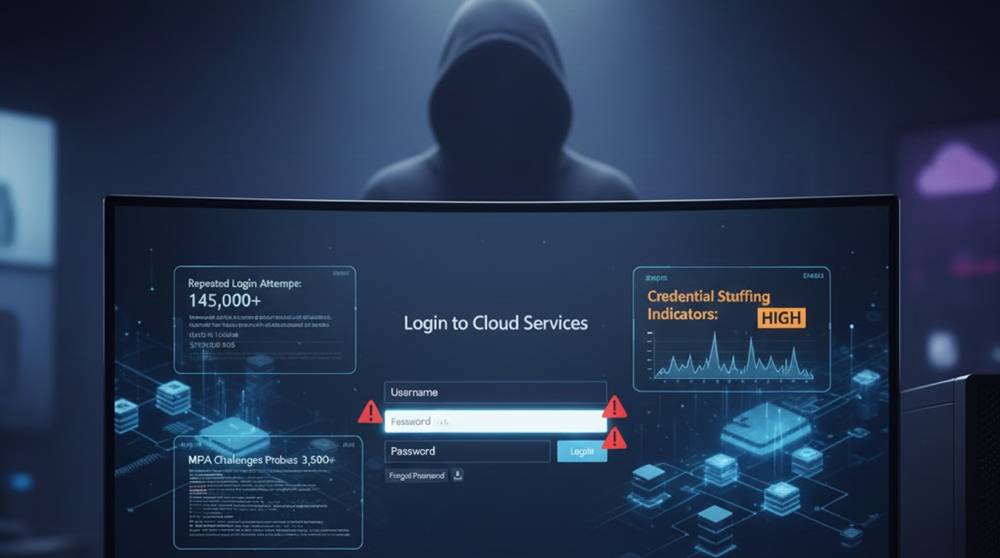
Cloud login pages sit at a unique intersection of trust and access.
They are familiar to employees, partners, and executives.
They look the same every day.
They are used under time pressure.
From an attacker’s perspective, they offer a single opportunity to gain broad access without triggering alarms.
This is not about exploiting software flaws.
It is about exploiting routine.
What makes cloud logins different
Traditional systems often had layered entry points.
Cloud platforms centralize access.
One login can lead to:
1. Email
2. File storage
3. Internal applications
4. Administrative consoles
5. Third-party integrations
For attackers, this concentration reduces effort and increases payoff.
How cloud login pages are abused in practice
Credential harvesting, not system hacking
Most incidents do not involve breaking the cloud provider.
Instead:
1. Users are redirected to convincing look-alike login pages
2. Credentials are captured in real time
3. Access is used immediately, often within minutes
The cloud platform behaves exactly as designed.
Real incident: Executive mailbox takeover
An executive approved a document request from a familiar sender.
The link led to a cloud login page that looked identical to the real one.
The credentials were entered.
Multi-factor approval followed, out of habit.
Within 20 minutes:
1. Mail rules were changed
2. Conversations were monitored
3. A payment request followed
No malware was involved.
No alerts fired.
Real incident: Partner access abuse
A shared cloud workspace was used by multiple companies.
One partner’s credentials were stolen through a fake login page.
Attackers gained:
1. File access
2. Contact lists
3. Internal project context
Trust between organizations amplified the impact.
Many users are duped into using these false cloud login pages because the processes seem normal. Some factors that may contribute to the possibility of falling victim to a fake cloud login page are:
1. You can use a single-sign-on for all of your accounts
2. Constantly being prompted to log in again
3. Using a similar design - even if it relies on a different color palette
4. Using mobile devices to access an account that doesn't show much information being displayed
As a result of everything appearing normal, individuals are less likely to pay attention to any warning signs.
Because security is primarily concerned with a technical "hacker", traditional security measures are unable to identify cloud login scams as legitimate technical attacks, they are actually legitimate access points from the perspective of the individual who logs in through the cloud service.
Security controls such as detecting malware, network activity or endpoint protection are unable to detect anything unusual about an individual's activity on these types of site. It is only when the individual logs out of their account when the activity appears as being suspicious in nature.
Business consequences beyond access
The real cost is rarely the initial login.
Organizations experience:
1. lengthened internal investigations
2. Notification of legal and regulatory requirements
3. Loss of confidence among partners
4. Loss of credibility within the organization's executive staff
5. Delays in operational processes as an organization determines the extent of access to the Internet.
Recovery focuses on trust, not systems.
The Risk Mitigation Strategies
In order to mitigate risks, organizations should focus on the behavioral and procedural elements of their Risk Mitigation Strategies.
Effective Mitigation Strategies include:
1. The establishment of specified rules for approving Internet log-ins;
2. The establishment of mandatory verification processes for sensitive actions (i.e., sending email);
3. The use of conditional access to the Internet based on date and time of access, or device used to access, etc.
4. The ability to quickly revoke sessions when there is suspicion that there has been a takeover of the organization's systems.
5. The executive staff is aware of the patterns of abuse associated with their Internet log-in information.
To be effective, all of the Risk Mitigation Strategy controls must be consistently enforced.
Questions leadership should be asking
1. How quickly can access be revoked after a suspected takeover?
2. Which roles have the broadest access after login?
3. Are executives trained on authentication fatigue risks?
4. Do partners authenticate with the same rigor as employees?
5. How often are login-related incidents reviewed at board level?
These questions surface exposure that dashboards often miss.
Cloud login pages are not just entry points.
They are decision points made under pressure.
Attackers succeed by blending into routine behavior, not by breaking technology.
Reducing this risk requires governance, clarity, and leadership alignment more than new security tools.