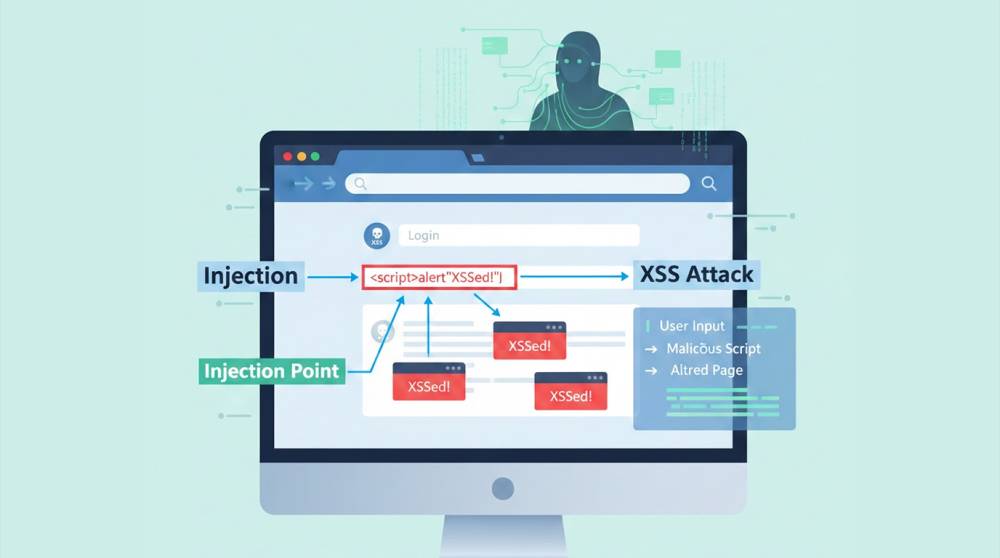
Cross Site Scripting, usually called XSS, happens when a website shows user input without properly checking it first.
In simple terms:
the website trusts data it shouldn’t trust.
When that happens, an attacker can inject content that runs in a visitor’s browser as if it came from the website itself.
No hacking skills required from the victim. Just visiting the page is enough.
Why XSS Still Matters Today
XSS is not new.
Yet it continues to appear in modern websites, cloud apps, and internal tools.
Why?
1. Web apps change fast
2. User input exists everywhere (search boxes, comments, forms)
3. Developers focus on features first, security later
4. Browsers automatically trust content from legitimate websites
XSS doesn’t break servers.
It abuses trust between the site and the user.
How to Develop an XSS Attack Using Real Life Examples?
Picture a notice board for your workplace that is open to all employees, on this board any employee can put a note up, one day an employee puts up a note that appears to be from management with instructions on what to do, other employees who see the note assume that it is from management and will follow the instructions. This scenario is indicative of a type of attack known as Cross-Site Scripting (XSS).

Examples of XSS Attacks That Use Real Life Scenarios:
1. Cross-Site Scripting on Social Media Sites:
Cross-Site Scripting attacks on social media sites allowed attackers to post content which executed scripts on all user's computers when they opened the post.
2. Cross-Site Scripting on Webmail Services:
XSS attacks on webmail services allowed attackers to steal session cookies just by opening an email message.
3. Cross-Site Scripting on Internal Dashboards:
XSS vulnerabilities on admin panels allowed attackers to take control of the admin's session without any indication that their session had been compromised.
Most XSS attacks occur with no malware actually being downloaded.
The victim's web browser carries out the attack.
Reasons XSS will go unnoticed:
1. It is often mistaken for standard browser activity.
2. Unlike a virus, it doesn't produce warning messages or cause your system to crash.
3. Log file data may not appear abnormal at first glance.
4. Users presume it to be a “glitch” in their browser.
5. Security solutions may not identify, alert on or block this type of issue.
Silent problems are dangerous problems.
Ways to reduce the risk of XSS for developers/site owners:
1. Always validate and sanitize every piece of submitted user input.
2. Always encode all user output (excluding HTML).
3. Utilize current versions of web applications with integrated protection against XSS attacks.
4. Utilize a Content Security Policy (CSP).
5. Review any JavaScript code dealing with URLs and/or user input.
Some suggestions for reducing the risk of XSS for users:
1. Make sure your browser is current.
2. Be cautious of links that contain unknown or peculiar query string parameters (e.g., "?").
3. Always log out of any application that requires sensitive information once you have finished using the application.
4. If you notice unusual activity on a website, report it instead of ignoring it.
The following are some resources intended to assist Organizations and Individuals in learning about XSS and learning to test their environments for true XSS vulnerabilities.
1. OWASP ZAP (an automated scanner for testing Web Application security)
2. Burp Suite Community Edition (a tool for analyzing or manually inspecting HTTP request and response data)
3. Mozilla Observatory (a scanner for verifying that a website has implemented proper security headers)
4. Security Headers.com (provides a summary of all security headers present on a webpage)
5. The Browser Developer Tools (these include the Elements tab, where you can safely inspect many elements, including security-related properties).
Key Points:
1. XSS exploits the trust in a browser rather than the trust in the application running on the server.
2. Anyone visiting a page that has a Vulnerability to an XSS attack can be affected.
3. The growing demand for speed and complexity of web applications allows for much greater opportunities to be vulnerable to XSS attacks.
4. It is more cost-effective to Prevent Security Issues than it is to repair Security Issues after they have occurred.
5. Awareness of XSS and Security Risks are just as important as having the tools to monitor, detect and mitigate these threats.