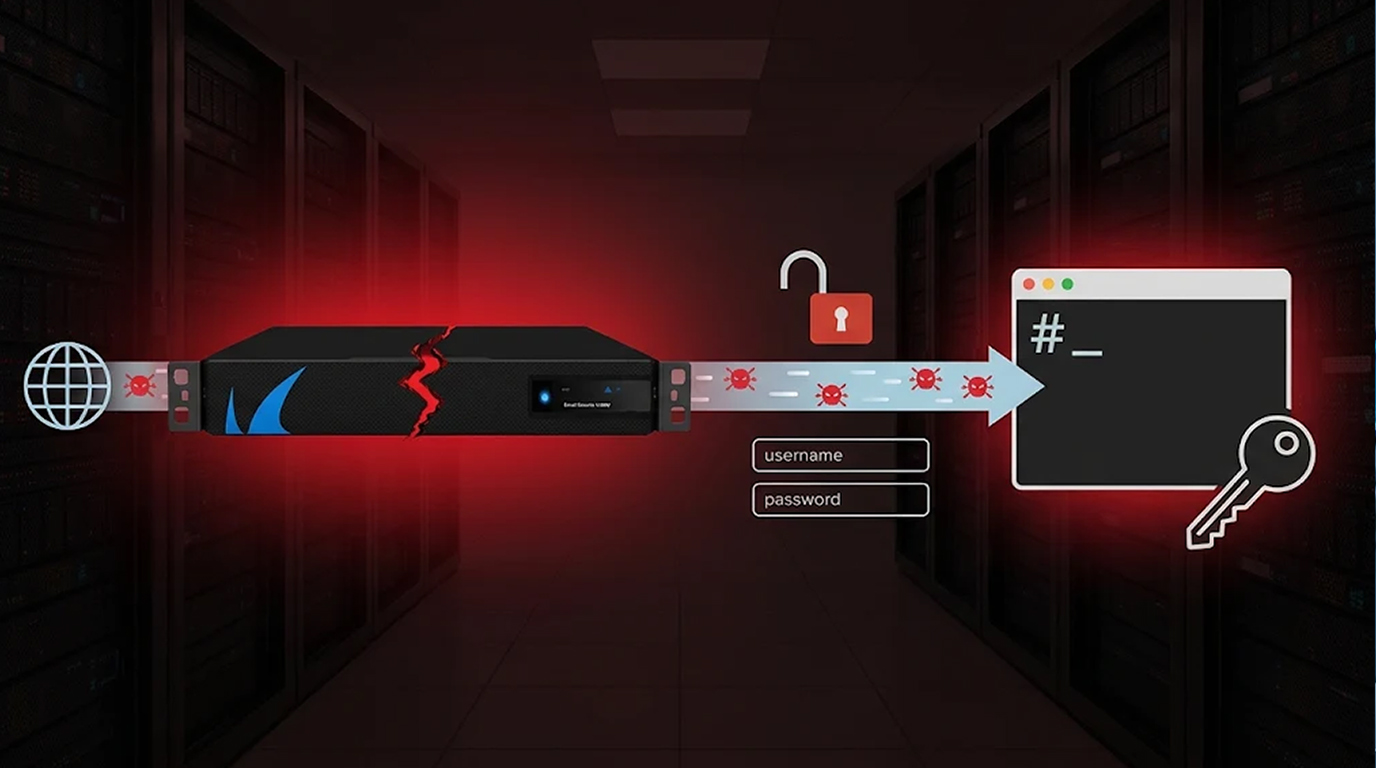
Barracuda patched two vulnerabilities in its Email Security Gateway on Monday. By Thursday, watchTowr had published a full technical breakdown of how an attacker can chain them into root-level command execution without logging in.
Neither flaw is severe enough to do that on its own. That is the point.
The authorization bypass, CVE-2026-116606, is rated 9.3 by Mandiant. The command injection, CVE-2026-111560, is rated 8.6. Separately, they are serious but containable. Together, they hand an unauthenticated attacker the highest level of access the appliance offers.
What Each Flaw Does
|
CVE |
CVSS |
Type |
What It Provides |
|
CVE-2026-116606 |
9.3 |
Authorization bypass |
Lets an unauthenticated attacker restore a crafted config backup and change global settings |
|
CVE-2026-111560 |
8.6 |
Command injection |
Runs commands as root, but normally requires an administrator account |
The second flaw exists in six products. On the other five, it still needs an administrator account to reach. Only the Email Security Gateway has the bypass that supplies one.
Barracuda fixed the Email Security Gateway in firmware version 9.4.0.030 and later. The company published patches for each affected product and lists the fixed firmware in its security advisory.
How the Chain Actually Works
watchTowr traced the sequence through the appliance's code, and the first step is the interesting one.
When a password change fails, the appliance returns a low-privilege role instead of rejecting the request outright. That response leaves a backup-restore function reachable by someone who has never logged in.
The restore function accepts an uploaded backup file. Inside that backup, one of the restored values is a timezone setting. Later, the appliance executes that timezone value as a shell command, with root privileges.
Barracuda does protect backups with a checksum. But the secret used to compute that checksum is hardcoded in the code. Anyone who reads the appliance's firmware can forge a valid checksum for a malicious backup.
watchTowr demonstrated the chain by writing a file to the appliance as root.
What Defenders Should Do
Barracuda's advisory lays out three steps, and the order matters less than doing all three.
- Patch every affected product. Or upgrade to the fixed firmware listed in the advisory. For the Email Security Gateway, that is 9.4.0.030 or later.
- Restrict the administration interface to trusted internal networks if you cannot patch right away. That removes the exposure path while you schedule the update.
- Turn automatic patching back on if it has been disabled. Appliances with auto-patching off are the ones that stay vulnerable months after a fix ships.
The Detection Tool
watchTowr released a detection tool that checks whether an appliance is vulnerable. It did not publish an exploit.
That distinction matters, because it means the tool lets defenders assess their fleet without handing attackers a working payload. It also means the window between "detectable" and "exploitable by anyone reading a blog post" is still open.
Exploitation Status
Neither flaw appears in CISA's Known Exploited Vulnerabilities catalog as of this week. No public report ties either one to an attack.
It is worth noting that the Email Security Gateway was hit in 2023 by a group tracked as UNC4841, which exploited CVE-2023-2868 as a zero-day. That campaign is unrelated to the two flaws patched this week, and nothing connects the new pair to any attacker.
But the history is relevant context. This is an appliance that has been targeted at the edge before, and it is the kind of device that sits directly on the internet.
Why This Chain Is a Useful Case Study
Three design decisions lined up here, and each one is defensible in isolation.
A failed password change returning a low-privilege role instead of halting the request is a defensive-sounding choice. It avoids leaking information about whether the account exists. But it also leaves a code path open that should have been closed.
A backup-restore function that accepts uploads from any caller is convenient. Until the caller has not authenticated.
A checksum that uses a hardcoded secret provides integrity against corruption. It does not provide integrity against an attacker who has the firmware.
None of these is a catastrophic mistake. Together, they are root.
FAQ
What are CVE-2026-116606 and CVE-2026-111560?
CVE-2026-116606 is an authorization bypass in Barracuda Email Security Gateway that lets an unauthenticated attacker restore a crafted configuration backup. CVE-2026-111560 is a command injection that runs commands as root but normally requires an administrator account.
How do they chain together?
The authorization bypass grants the low-privilege role needed to reach the backup-restore function. The restore accepts a malicious backup, and a timezone value inside it is later executed as a root shell command.
Why does the checksum not stop this?
Because the secret used to compute the checksum is hardcoded in the appliance's code. Anyone who reads the firmware can forge a valid checksum.
Which products are affected?
The authorization bypass affects only the Email Security Gateway. The command injection affects six products in total, but on the other five it still requires an administrator account.
What version fixes the Email Security Gateway?
Version 9.4.0.030 and later.
Has this been exploited in the wild?
Neither flaw is in CISA's KEV catalog as of this week, and no public report ties either to an attack. watchTowr released a detection tool but did not publish an exploit.
Is this related to the 2023 UNC4841 attacks?
No. Those attacks used CVE-2023-2868, a different zero-day. Nothing connects the two flaws patched this week to that campaign.
What if I cannot patch immediately?
Restrict the appliance's administration interface to trusted internal networks. That closes the reachable path while you schedule the firmware update.